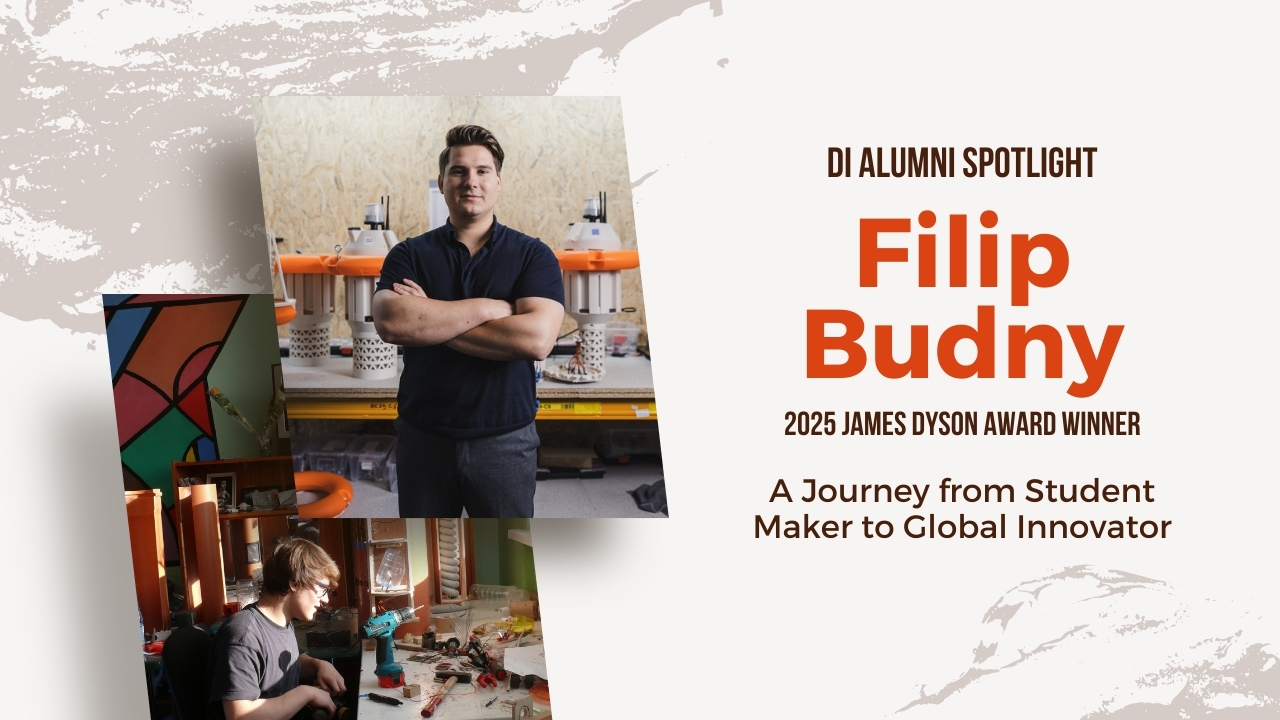
When a toxic algal bloom devastated the Oder River in Poland in 2022, it wasn’t just an environmental disaster, it was a wake-up call. For Destination Imagination (DI) alum Filip Budny, it became the moment that set everything in motion. Seeing hundreds of tons of fish washed ashore and realizing no system had caught the warning signs in time made him ask a question that would shape his future: How could something this big happen without any early warning?
That question eventually became WaterSense, an autonomous, AI-powered water-monitoring system now being deployed across Poland and garnering global attention. In November 2025, WaterSense earned Filip the James Dyson Award for Global Sustainability, selected from more than 2,100 inventions across 28 countries.
Today, we’re excited to share Filip’s story and how his journey in Destination Imagination helped shape the way he approaches creativity, engineering, and innovation.
Q&A with DI Alum Filip Budny
1. Congratulations on winning the International James Dyson Award! What does this recognition mean to you personally, and what has the response been like since the announcement?
Winning the International James Dyson Award has been an extraordinary moment for me — not only as a scientist and engineer, but also as someone whose journey began in Destination Imagination. DI taught me that imagination, teamwork, and the courage to take on real problems can change the world. This recognition feels like a continuation of that path.
The Award is also meaningful because WaterSense was born out of the 2022 ecological disaster on the Oder River. It started with a simple question: “How could this happen without anyone noticing?” Receiving global recognition now shows that protecting inland waters is a challenge the world is ready to take seriously.
Since the announcement, the response has been overwhelming. Environmental agencies, researchers, investors, and universities have reached out. We’re now discussing new pilots across Europe, including the Rhine, Vistula, and Oder rivers. Schools and innovation hubs have also contacted us. Most of all, this Award inspires young innovators to believe that engineering can drive real impact — that’s the greatest reward.
2. In 2022, the ecological disaster on the Oder River exposed serious gaps in how inland waters are monitored. Can you describe the moment you realized, “This is a problem I need to solve”?
The turning point was the disaster itself — seeing hundreds of tons of fish washed ashore and realizing no early warnings existed. Growing up in Masuria, surrounded by lakes, water has always been close to me. Watching a river ecosystem collapse overnight felt deeply personal.
What struck me most was the complete lack of real-time data. Inland waters were being monitored manually, as if nothing had changed since the 20th century. With my background in mechatronics, printed electronics, and electrochemistry, I realized I had the skills to create something better. What began as frustration quickly became a mission.
3. For readers who may be new to water monitoring, what makes WaterSense different from traditional tools, and why does that difference matter?
Traditional monitoring is slow and reactive — you take a sample, send it to a lab, and get results days later. WaterSense flips that model entirely.
It’s continuous, autonomous, and predictive. Each station can measure over 25 parameters every 10 minutes, renew its own sensors daily, and use AI to forecast problems up to 72 hours in advance. Instead of snapshots, it provides a living, real-time picture of water quality.
Traditional tools tell you what has already happened. WaterSense tells you what’s happening now—and what’s coming next. That shift from reaction to prevention is transformative.
4. WaterSense includes features like printed disposable sensors, self-calibration, and AI forecasting. Which part of the design challenged your creativity the most, and why?
The biggest creative challenge (and the most rewarding one) was designing the printed disposable sensors. We were inspired by glucose test strips, which are inexpensive, precise, and contamination-resistant.
We created a roll of printed electrochemical sensors that automatically advance every day, like camera film. It required combining materials science, electrochemistry, mechanics, and embedded systems.
Solving that problem unlocked autonomous, long-term, lab-grade monitoring — something traditional systems simply can’t do.
5. You’re a Destination Imagination alum! Which years and Team Challenges did you participate in, and what stands out most from those experiences?
Yes, I’m a proud DI alum! I competed with team Winders in 2013 and 2014 when I was about 16 years old. We took on the Technical Challenge that season, and our DI journey took us across the world. We won the Polish National DI Tournament, then represented Poland at the DI China Tournament in Beijing, where we won the special National Geographic Challenge, and then competed at Global Finals in Tennessee.
What stands out most is the scale: thousands of young people engineering, building, inventing, and creating. DI showed me that creativity is a skill you practice, and that when you combine imagination with teamwork, you can build things that genuinely matter. DI didn’t just teach me how to solve problems; it shaped the way I approach every challenge today, including WaterSense.
6. DI emphasizes breaking down complex problems, prototyping quickly, and testing ideas under real constraints. How did those skills show up while you were building WaterSense?
DI shaped the way I build things long before WaterSense ever existed. As a teenager in DI, my team and I took on a Technical Challenge where we designed a concept device to help humans survive on Europa — Jupiter’s moon — and presented it through a theater performance. It sounded like science fiction, but DI teaches you to think without limits, break problems into manageable parts, build quickly, and refine constantly. That mindset has stayed with me.
When I began developing WaterSense, I approached it the same way. We didn’t wait for a perfect blueprint — we prototyped fast, tested in real rivers, saw what broke, and iterated right away. Sometimes we built a component in the morning and tested it in the water that same afternoon. Real-world feedback became our primary design tool.
That rapid cycle of build → test → fail → improve is pure DI. It’s a big reason we were able to create the first working prototype in under six months. DI taught me that innovation isn’t about getting it right the first time; it’s about iteration, teamwork, resilience, and solving real problems with creativity.
7. DI’s Creative Process is non-linear and encourages teams to recognize a problem, imagine possibilities, collaborate and initiate action, assess results, and keep improving. Where did that approach show up in your development of WaterSense?
The DI Creative Process is present at nearly every stage of building any product — and each part of it matters. DI teaches you to recognize a problem, imagine bold solutions, test them quickly, and refine what you’ve learned. That mindset became central to how we developed WaterSense.
In the early prototypes, we didn’t chase perfection. Instead, we focused on fast, structured iteration. We put the first versions of the station into real conditions, watched what broke, and redesigned immediately. Every leak, mechanical issue, or sensor misreading simply pointed us to the next improvement. It wasn’t about following a formal sequence; it was about embracing the iterative way of thinking that DI naturally builds into you.
That philosophy — imagine, test, improve — became not just a creative tool from DI, but a practical product-development strategy. It’s what allowed WaterSense to progress from an idea to a functioning system in just a few months.
8. Now that more than 20 WaterSense prototypes are deployed, what has surprised or excited you most from the real-world data you’re seeing?
What has surprised me the most is just how fast inland waters change. Monitoring rivers and lakes every 15 minutes reveals dynamics we could never see before. A shift in rainfall, a change in flow, a nearby industrial discharge, even activity in a small tributary — all of it shows up almost instantly in the data.
It has also been eye-opening to see how strongly human activity shapes water quality. Sometimes a single event upstream can alter conditions for kilometers within just a few hours. The AI model captures these patterns clearly, revealing relationships between environment, weather, and human behavior that traditional methods could never show.
The most exciting part is that these insights are actionable. When we understand how quickly water responds — and how much influence we actually have — we can finally move from reacting to problems to preventing them. That, to me, is the real power of seeing water in real time.
9. WaterSense will expand across Poland, Europe, and eventually the U.S. What’s your long-term vision for how this technology could change the way communities and governments protect their water?
My long-term vision is to make water quality data accessible to everyone. I want to make checking the health of a river or lake as normal as checking the weather.
I want WaterSense to help create the world’s first real-time digital model of inland waters: a constantly updated “digital twin” that shows what’s happening in rivers and lakes across entire regions. With thousands of autonomous stations feeding data into AI, we could see changes as they happen, understand how different factors affect the water, and predict risks before they become disasters.
A system like this could fundamentally change how we protect inland waters. When communities, governments, and companies all have access to the same real-time information, they can make faster, smarter, and more sustainable decisions.
10. What advice would you give to young people who want to use their creativity to make a difference in the world?
My advice is simple: follow the same approach DI teaches — because it applies to anyone who wants to solve real problems.
Recognize a problem. Imagine solutions. Build something. Test it. Fail. Improve. Don’t wait for the perfect plan — just start.
And if you don’t see a problem right away, wander a bit. Stay curious. Every meaningful innovation begins with noticing something others overlook.
Creativity isn’t about having flashy ideas; it’s about helping people and the planet in a practical, meaningful way. If you stay curious, stay open, and keep building, you’ll be surprised how quickly your ideas turn into something real.