
One of the most important parts of the Destination Imagination (DI) Challenge Experience is that the team’s Challenge solution—from the first idea to the final presentation—belongs to the students.
That can also be one of the hardest parts of being a Team Manager.
Your team may disagree about which direction to take, struggle to get an idea to work, or realize they’re running out of time to finish everything they planned. You might see a problem coming long before they do. And sometimes, it takes everything in you not to jump in and help.
But those moments are an important part of the learning process.
Interference happens when someone outside the team contributes ideas, creates any part of the team’s solution, or makes decisions about the solution for the team. Only team members can contribute ideas and create their Team Challenge solution.
So what can you do when your team needs help? Understanding where that line falls is one of the most important parts of being a Team Manager. Here’s how you can support your team without taking over their work.
Why Letting Your Team Figure It Out Matters
Imagine your team is building a structure for their Engineering Challenge. You’ve noticed a potential weakness in their design, and you suspect it may not perform the way the team expects.
Do you say something? Suggest a different approach? Show them how you would build it?
As tempting as it might be, the answer is no.
Instead, give your team the opportunity to test their design and see what happens. If it doesn’t work the way they expected, they might figure out what’s wrong and find a way to fix it. Or they might try several approaches and still not get it to work. Either way, they’re learning from the experience and making their own decisions about how to move forward.
This is an important part of the DI Creative Process. Students generate and develop their own ideas, put them into action, assess how things are going, and decide what to do next. Sometimes teams will need to rethink an idea or start over. Other times, they’ll have to decide what they can realistically accomplish with the time and resources they have left.
When students work through these challenges together without adults stepping in to solve problems for them, they build skills in critical thinking, collaboration, communication, and problem-solving.
Your role isn’t to make sure everything goes according to plan. It’s to support your team as they work through the process themselves.
What Can Team Managers Do Without Interfering?
Following the Interference policy doesn’t mean you have to sit on the sidelines. Team Managers play an active role throughout the DI season. They can teach skills, help students understand their Challenge and the rules, support project management, guide them through the DI Creative Process, and keep students safe.
Here are some ways you can support your team:
- Teach new skills. Team Managers can show students how to safely use a power tool, teach basic coding skills, or demonstrate a performance technique. The team then decides how to apply those skills to its Challenge solution and does the work itself. Teaching skills is allowed; applying those skills to the solution is the team’s responsibility.
- Help them stay organized. Team Managers can create meeting schedules and calendars, introduce project management tools, help track deadlines, and keep the team focused on the goals and plans they’ve set. Younger or newer teams may need more support with project management. As they gain experience, Team Managers can gradually give them more responsibility for managing their own work.
- Guide them through the DI Creative Process. Team Managers can teach students how to use the idea-generating and focusing tools in Roadmap, encourage experimentation and exploration, and help them reflect on their progress. These tools can help teams consider different possibilities and make decisions together, while the ideas and decisions remain their own.
- Help them understand the Challenge and rules. Team Managers can help students understand Challenge requirements and learn how to find the information they need. Encourage them to reread their Challenge, check Rules of the Road and Published Clarifications, or request a Team Clarification when appropriate. Understanding the Challenge and rules is something Team Managers and team members can work on together.
- Keep safety a priority. Team Managers can teach safe practices, establish safety rules, point out something they believe is unsafe, and prevent the team from engaging in unsafe behavior. If a safety concern means the team needs to change its approach, the team must decide what to do instead.
- Ask open-ended questions. Team Managers can ask questions that help students think through a problem without pointing them toward a particular answer. For example, you might ask, “What have you tried so far?” or “What did you learn when you tested it?” The key is to avoid questions that suggest an idea or steer the team toward a particular solution.
Understanding the Interference Triangle
The Interference Triangle is a helpful way to understand how Team Managers can support their team without contributing to the team’s solution.
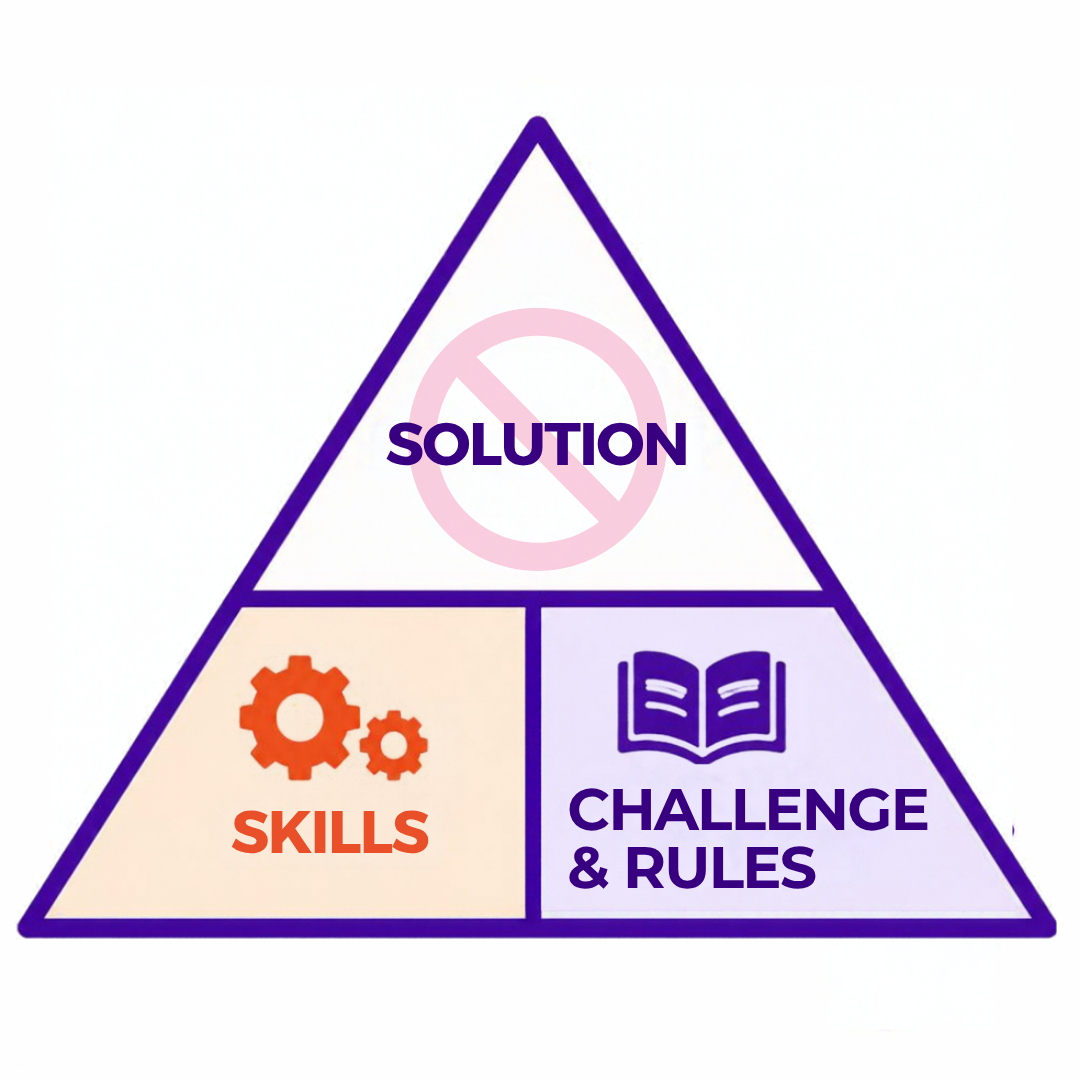
At the base of the triangle are two areas where Team Managers and others can help:
Skills: Students bring existing skills to their team and learn new ones throughout the season. Team Managers and other adults can teach skills, but the team decides how to apply those skills to its Challenge solution.
Challenge & Rules: The Challenge, Rules of the Road, and Published Clarifications are resources that teams and Team Managers can read, discuss, and work to understand together.
At the top of the triangle is the team’s solution. The ideas and decisions belong to the team, and only team members can create the elements that become part of their solution.
You’ll also find the Interference Triangle in Rules of the Road, so you can refer to it throughout the season if you’re unsure whether a particular type of help is allowed.
Hear from a DI Team Manager
Sometimes it helps to hear how another Team Manager approaches Interference.
In this video, veteran DI Team Manager and teacher Lisa Mackey shares practical tips for supporting students throughout the season without taking over their work.
More Resources for Team Managers
Whether you’re managing a team for the first time or returning for another season, these resources can help you better understand DI’s Interference policy and your role as a Team Manager.
- Rules of the Road: Review the official Interference policy and other important program rules. Available in the DI Resource Area.
- Roadmap: Reinforce your understanding of Interference with the Interference Quiz and find additional Team Manager tips, activities, tools, and templates for idea generation and focusing, project management, reflection, meeting planning, and more. Available in the DI Resource Area.
- Understanding Interference course: Explore Interference in greater detail through the DI Learning Portal.
Give Your Team Room to Figure It Out
There will be moments this season when your team struggles with a decision, an idea doesn’t work, or progress feels slower than you’d hoped. You may be tempted to step in–especially when you know you could help them get there faster.
But getting there faster isn’t the point.
As a Team Manager, you can teach, ask questions, help your team stay organized, and make sure they’re working safely. Then you give them the space to make their own decisions, test their ideas, learn from what happens, and decide what to do next.
And when they present their solution at a tournament, they can be proud knowing the ideas, decisions, and work were their own.